There's currently no search results available...


Ask five people what composable commerce vs headless vs modular means and you might get five different answers. Sometimes, these terms are used interchangeably in the bigger discussion between traditional architecture and modern options. But, the terms aren't exactly synonymous.
Why does the difference matter? Many B2B companies that want to modernize digital commerce will shortlist various vendors. And the terms composable, headless, and modular will keep appearing in the process, not always with much clarity.
Vendors blur the lines and buyers are left trying to work out whether they need a better customer portal, a more flexible commerce platform, a specialist tool for one capability, or a full platform replacement.
It's important to know how much architectural change you actually need – without turning modernization into a risky, expensive replatforming project. The wrong architecture decision can create the exact outcome modernization was supposed to avoid: higher cost, more complexity, slower delivery, and another major migration a few years later.
What is the difference between composable commerce vs headless vs modular?
Here's the short answer about the difference:
- Headless separates the buying experience from the systems behind it.
- Modular separates commerce capabilities from each other.
- Composable lets companies add, configure, and combine commerce capabilities across existing systems and specialist tools without replacing everything at once.
Though they don't mean the same thing, these terms don't compete. They work together to describe different layers of flexibility.
| What does it refer to? | When to use this architecture |
| Headless refers to the separation of the buying experience from the systems behind it. | Use headless where the buying experience needs more flexibility and you need to support different digital touchpoints |
| Modularity separates commerce capabilities from each other. | Use modularity where specific capabilities constrain growth and you need to change once capability without disrupting the rest |
| Composability separates business needs from fixed platform boundaries. | Use composability where the business needs to combine new capabilities with existing systems and specialist tools |
For B2B companies, the practical question is not whether the company “is headless,” “is modular,” or “is composable.”
The practical question is how to modernize commerce in a way that matches the company’s reality.
That may start with a better customer portal. It may continue with replacing one capability that has hit a ceiling. And over time, it may become a commerce setup that keeps adapting as customer expectations, partner models, and business requirements change.
Let's dive deeper into each term.
What is headless commerce (or API-based)?
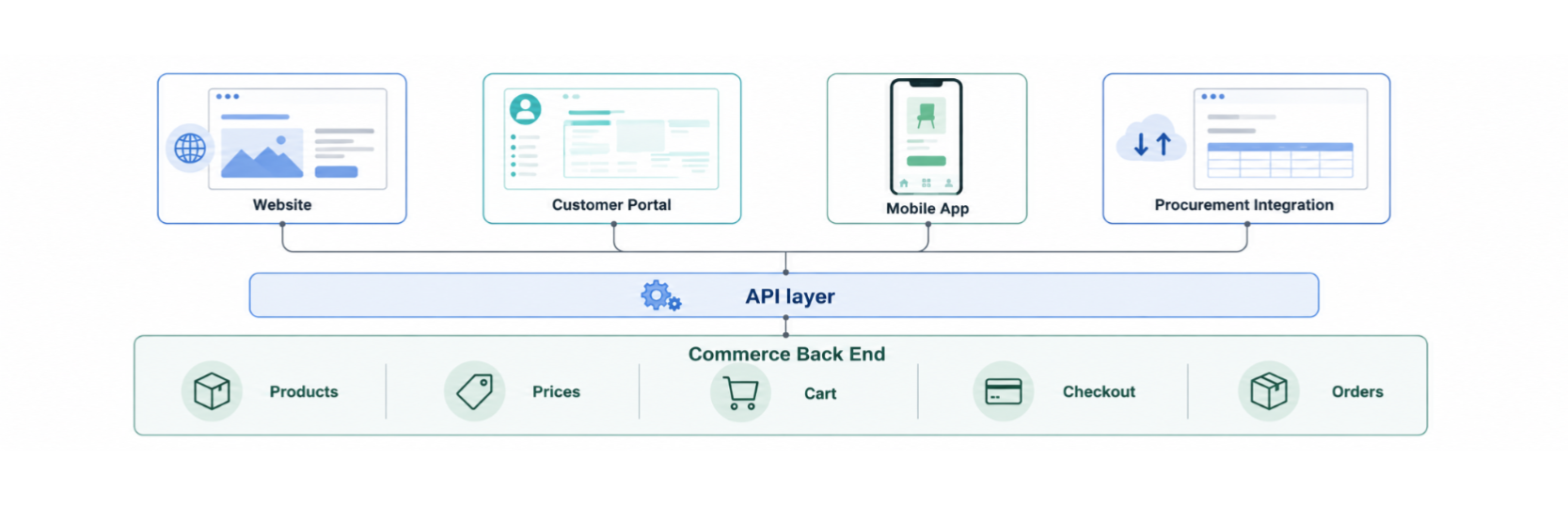
API-based commerce, often called Headless, decouples a company’s commerce front end from its commerce back end.
In plain language: your website, customer portal, mobile app, or procurement integration no longer has to be hardwired to one commerce system. Instead, it can use APIs (structured connections between systems) to request product data from a PIM, content from a CMS, prices or quotes from an ERP etc.
That means the same commerce capabilities can support different buying experiences:
-
A B2B self-service portal can show contract-specific products and prices
-
A mobile app for field technicians can pull spare-parts data
-
A customer-specific ordering interface can apply account rules
-
A punchout connection can send cart information into a customer’s procurement system.
Headless answers one question: How do I offer better digital buying and service experiences without being held back by the systems behind them?
The benefit of Headless is flexibility at the experience layer. You can improve what buyers see and use without rebuilding the systems that manage product data, pricing, checkout, and orders.
The caveat: “headless” only works well if the APIs are strong enough. If they are incomplete, inconsistent, or added as an afterthought, the company may still struggle to connect new portals, apps, or procurement integrations.
What is modular commerce?
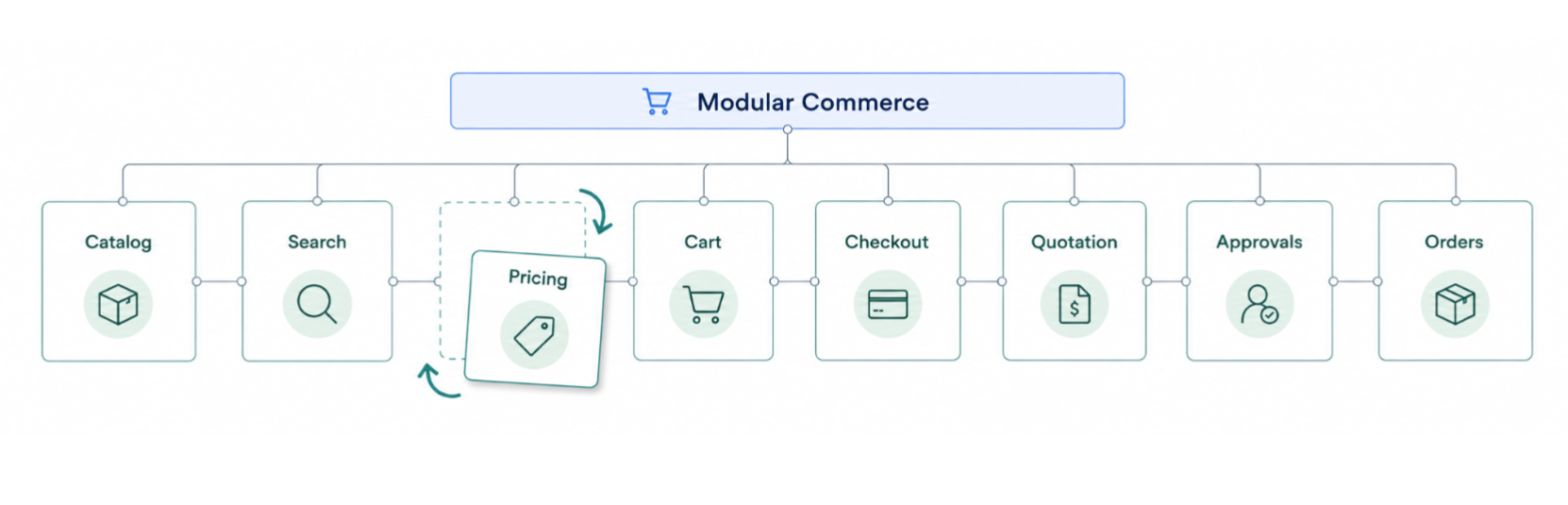
Modular commerce extends Headless by decoupling the back-end commerce capabilities into separate, independently usable business modules.
Where headless separates the buying experience from the systems behind it, modular commerce separates those underlying capabilities from each other.
In plain language: capabilities such as product catalog, search, pricing, cart, checkout, quotation, approvals, reorder, and returns are no longer treated as one tightly bundled system. They can be adopted, changed, scaled, or replaced more independently.
Modular commerce answers a different question: How do I change one commerce capability without disturbing everything else
For example, you may want to improve search and product discovery without replacing pricing. Or add quotation workflows without rebuilding checkout. Or introduce spare-parts self-service while keeping existing ERP logic in place.
This is where the term packaged business capability, or PBC, often appears. But for buyers, the label matters less than the practical test:
Can this capability be adopted, changed, scaled, or replaced without forcing a wider platform migration?
-
If the answer is yes, modularity lowers the risk of modernization.
-
If the answer is no, the “module” may be more of a packaging term than an architectural reality.
What is composable commerce?
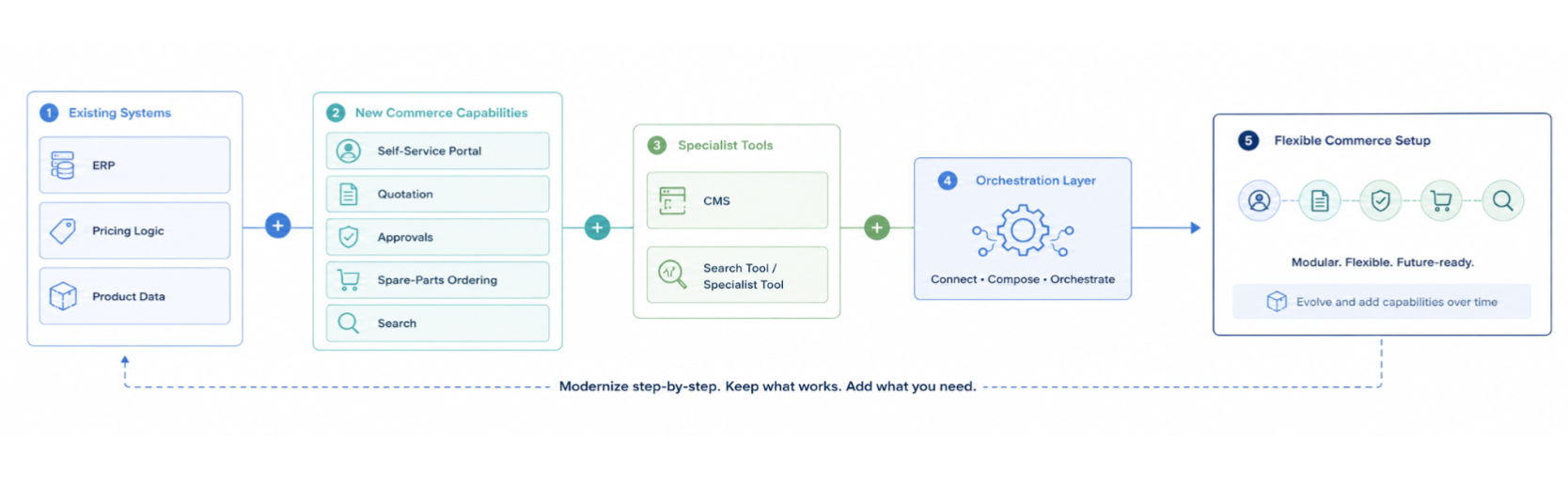
Composable commerce is the architecture that uses modular business capabilities to assemble the commerce setup a company needs.
In plain language: a company can combine new commerce capabilities, existing systems such as ERP or pricing logic, and specialist tools where needed – without having to replace everything at once.
Composable commerce answers the broadest question: How do I modernize commerce step by step while keeping what still works and adding what the business needs next?
The key idea is to make change easier and faster: adding, configuring, and combining capabilities across existing systems and specialist tools without turning every new requirement into a major custom-development project.
That might mean adding a modern self-service portal around an existing ERP. It might mean replacing search and product discovery without replacing product master data. It might mean adding quotation, approval workflows, or spare-parts ordering while keeping existing pricing and account logic in place.
How mature are these technologies?
This is where it helps to step outside vendor language and look at an independent maturity view.
The Gartner® Hype Cycle™ for Digital Commerce, 2026 is useful because it does not treat headless, modular, and composable commerce as buzzwords. It places them at different stages of market maturity.
In plain terms, the three ideas are related, but they are not equally mature, equally risky, or equally urgent.
| Gartner category | Gartner maturity and market penetration | Practical takeaway |
| (API-based) Headless digital commerce | Early mainstream. 20-50% market penetration | Increasingly a baseline for serious commerce modernization |
| Modular commerce | Early mainstream. 5-20% market penetration | A practical path to flexibility without replacing everything at once |
| Composable commerce | Adolescent. 1-5% market penetration | High potential, but requires stronger governance, integration skills, and digital maturity |
Source: Gartner, "Hype Cycle for Digital Commerce, 2026," Sandy Shen, 2 June 2026, ID G00846349. Maturity and market penetration reflect Gartner's entries for API-based Digital Commerce, Modular Commerce, and Composable Commerce. Gartner does not endorse any vendor, product or service depicted in its research publications.
What this means for B2B commerce modernization
For many manufacturers, the lowest-risk path is not a big-bang replatform.
It is to start with one constrained area where the business case is clear.
That could be after-sales self-service. Spare-parts ordering. Quotation workflows. Approval flows. Product discovery. Customer-specific catalogs. Distributor or service-partner integration.
The point is to modernize where the current setup limits growth or creates cost – while preserving the systems and business logic that still work.
That is the practical value of modern commerce architecture.
It gives B2B companies a way to move from legacy constraints to modern digital commerce without treating every modernization initiative as a full platform replacement.
If you want to see how Spryker puts headless, modular, and composable commerce into action for complex B2B use cases, get in touch or book a demo.
Frequently asked questions
Is headless the same as composable?
No. Headless separates the buying experience from the systems that manage the buying process. Composable commerce is broader: it is about combining capabilities, systems, and tools into a commerce setup that can adapt over time.
What is the difference between modular and composable commerce?
Modular commerce means commerce capabilities are separated into independently usable business modules. Composable commerce means the company can combine those modules with existing systems and, where useful, specialist tools.
Modularity makes composability more practical, but they are not the same thing.
Is composable commerce only about best-of-breed?
No. Best-of-breed means choosing specialist tools for specific jobs – for example, one vendor for payments, another for content, another for search, or another for product data.
That can be part of composable commerce. But for many B2B companies, the bigger value is adding or replacing specific capabilities while keeping important existing systems, such as ERP, pricing logic, order management, or customer-specific workflows.
Do B2B manufacturers need to replatform to modernize commerce?
Not always. The lower-risk path is often incremental: start with one capability that has a clear business case, connect it to the systems already in place, prove value, and expand from there.